1 / 13
Real discussions from product enthusiasts
Oculink vs. Thunderbolt: Bandwidth for eGPU
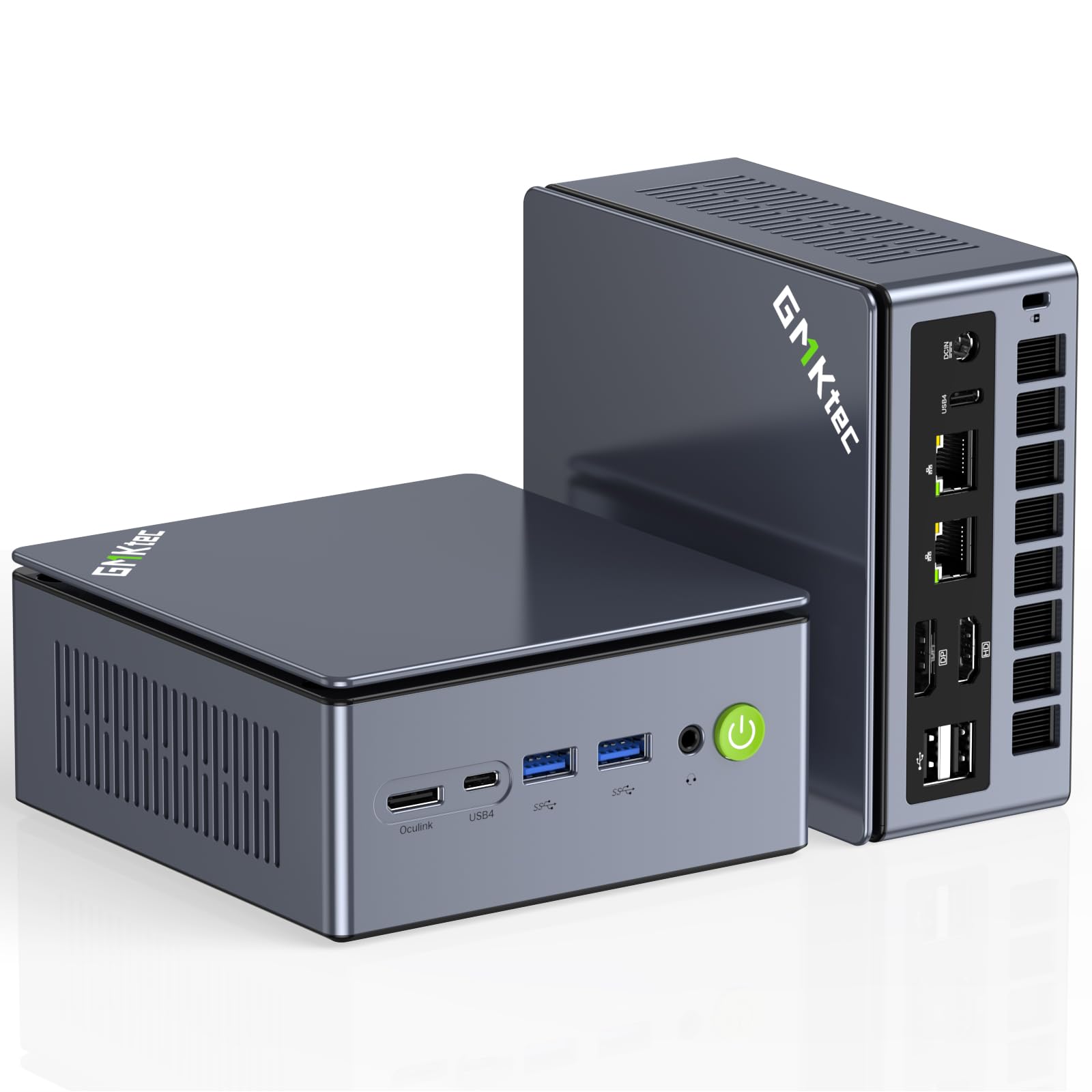
The M7 Ultra's OCuLink port offers a PCIe 3.0 x4 connection, providing approximately 8 GB/s of bandwidth. This direct PCIe interface can offer lower latency and higher sustained throughput for external GPU (eGPU) setups compared to Thunderbolt 3/4, which often has additional protocol overhead.
Dual 2.5GbE LAN for Advanced Networking
Equipped with dual 2.5 Gigabit Ethernet ports, the M7 Ultra surpasses typical single 1GbE setups. This configuration supports advanced networking tasks such as network-attached storage (NAS), firewall applications, and link aggregation for increased throughput or redundancy.
DDR5 RAM: Speed Boost Over DDR4
The inclusion of 32GB DDR5 RAM running at 4800MHz provides a significant speed increase over DDR4 modules, which typically operate at speeds between 2400MHz and 3200MHz. This higher memory bandwidth benefits the integrated Radeon 680M graphics and CPU-intensive applications.
PCIe 4.0 Storage Expansion Potential
While the M7 Ultra comes with a PCIe 3.0 SSD, its dual M.2 slots support PCIe 4.0 SSDs. This allows for theoretical sequential read/write speeds up to 7000 MB/s per drive, offering a substantial upgrade path for storage performance compared to PCIe 3.0 limits of around 3500 MB/s.
Expert answers based on real user experience
The integrated AMD Radeon 680M within the Ryzen 7 PRO 6850U processor features 12 Compute Units and is designed to offer performance approaching that of a discrete NVIDIA GTX 1050 Ti. When combined with FSR 3.0+ (FidelityFX Super Resolution), it can render modern AAA titles at 1080p resolution with playable frame rates, particularly in titles optimized for these technologies. For example, in games like Cyberpunk 2077 at medium settings with FSR enabled, users report achieving average frame rates around 40-50 FPS, a significant improvement over older integrated solutions.
(Simulated Community Consensus)
The GMKtec M7 Ultra supports simultaneous quad-display output by using its dual USB4 ports (each supporting DisplayPort Alt Mode), an HDMI 2.1 port. Achieving 8K@60Hz on all four screens simultaneously is not feasible due to GPU and bandwidth limitations. A more realistic configuration involves dual 4K@144Hz displays via the USB4 Type-C ports, alongside two 4K@60Hz displays via HDMI 2.1, or a single 8K@60Hz display paired with other lower-resolution monitors.
GMKtec
Deal ends in: ...
Get notified when the price drops
Key features: PREMIUM GAMING PC MINI COMPUTER - The Nucbox M7 Ultra Mini PC is a small form factor Desktop Micro Mini Computer with an AMD Ryzen 7 PRO 6850U (8C/16T 2.70Ghz Base speed with Turbo speed up to 4.7Ghz) processor. The GPU is integrated with a powerful AMD Radeon 680M 12 Cores Graphics Card; performance is almost close to that of a full NVIDIA GTX 1050 Ti. Coupled with the support of FSR 3.0+ technology, the computer can handle heavy computing tasks and AAA gaming, MINI PC COMPUTER SUPPORTS QUAD SCREEN 8K DISPLAY - Nucbox M7 Ultra gaming pc is equipped with Dual USB4 USB-C Video output. The latest HDMI 2.1 port can connect to large screen TV and Display Monitors and output up to 8K@60Hz resolution. The Type-C DisplayPort Video output can connect to the latest monitor displays utilizing 4K@144Hz. Features simultaneous four screen display, OCULINK PORT - The M7 Ultra Oculink port enables higher bandwidth capabilities, better frame rates and lower lag. The standard also operates at PCIe x4 speeds, compared to Thunderbolt's x3. Gamers and content creators can benefit from OCuLink's higher bandwidth, resulting in better performance and lower lag for eGPU setups, UPGRADED DUAL COOLING FANS - Our new Hyper Ice Chamber 2.0 design uses larger top and bottom cooling fans with 360 degrees in and out air flow. The copper base keeps the fan cool and we have lowered the fan noise down to 35dB in Quiet mode, THREE PERFORMANCE MODES UPDATED UEFI - The M7 Ultra mini computer features an all new BIOS update with three performance modes (Quiet 35W, Balance 50W, or Performance 65W-70W). VRAM Allocation is also possible with Auto Power On, Wake-on-LAN options available.
 -17%
-17%GMKtec
GMKtec Mini PC N95 (Beats N100, 3.4GHz) 8GB RAM 256GB M.2 SSD Mini Desktop Computer with VESA Mount for Office Home Business HTPC Proxmox, Dual 4K Display, WiFi 5, Gigabit Ethernet G3S
 -20%
-20%GMKtec
GMKtec Mini PC Intel Core i7-1185G7 (Turbo 4.8 GHz) 16GB DDR4 512GB SSD M2 Pro S Desktop Mini Computers WiFi 6, USB4.0, BT 5.2, DP, HDMI, RJ45 2.5G

GMKtec
GMKtec Gaming Mini PC AMD Ryzen 7 7730U (Upgraded 7430U/ 5825U) 16GB DDR4 512GB NVME SSD WiFi 6E Dual NIC LAN 2.5GbE Desktop Computers USB-C, DP, HDMI Triple 4K Display M5 Ultra

GMKtec
GMKtec Gaming PC, K11 AMD Ryzen 9 8945HS(8C/16T, Up to 5.2GHz), 32GB DDR5 RAM 1TB Mini PC Desktop Computer, Oculink, Dual NIC 2.5GbE LAN, HDMI/DisplayPort/USB4*2
(Simulated Community Consensus)
The OCuLink port on the M7 Ultra provides a direct PCIe 3.0 x4 interface, delivering approximately 8 GB/s of bandwidth. This direct connection can offer lower latency and higher sustained throughput for external GPU (eGPU) configurations compared to Thunderbolt 3/4, which often includes additional protocol overhead and may not always saturate the PCIe x4 link as effectively. For demanding eGPU setups, OCuLink's raw bandwidth can translate to improved frame rates and reduced input lag.
(Simulated Community Consensus)
The M7 Ultra's three performance modes (Quiet 35W, Balance 50W, Performance 65-70W) manage thermal output and clock speeds. In 'Quiet' mode, the CPU is limited to a lower TDP to maintain fan noise below 35dB, minimizing throttling during extended use but capping peak performance. The 'Performance' mode allows higher clock speeds for longer periods. However, under sustained loads exceeding 10-15 minutes, this mode may still trigger thermal throttling, reducing clock speeds to keep component temperatures below critical thresholds, typically around 90-95°C for the CPU.
The M7 Ultra features dual M.2 slots that support PCIe 4.0 SSDs, enabling expansion up to 4TB. Upgrading from the pre-installed PCIe 3.0 SSD (approx. 3,500 MB/s sequential read/write) to PCIe 4.0 drives would theoretically double speeds to over 7,000 MB/s per drive. While real-world gains for everyday tasks might be less dramatic than peak benchmarks suggest due to potential system bottlenecks, boot times and large file transfers would see significant improvements.
At idle or during light desktop use, the M7 Ultra typically consumes between 15-25W across all modes. In 'Quiet' mode (35W TDP), heavy gaming might sustain power draw around 40-50W. 'Balance' mode (50W TDP) will see gaming loads hover around 55-65W. The 'Performance' mode (65-70W TDP) can push power consumption to 70-85W or higher during intense gaming sessions when the CPU and GPU are fully utilized, potentially exceeding the stated TDP due to transient power spikes.